Gustav Klimt's Mother & Child, And Our Lady Of Kazan
· 3 min read
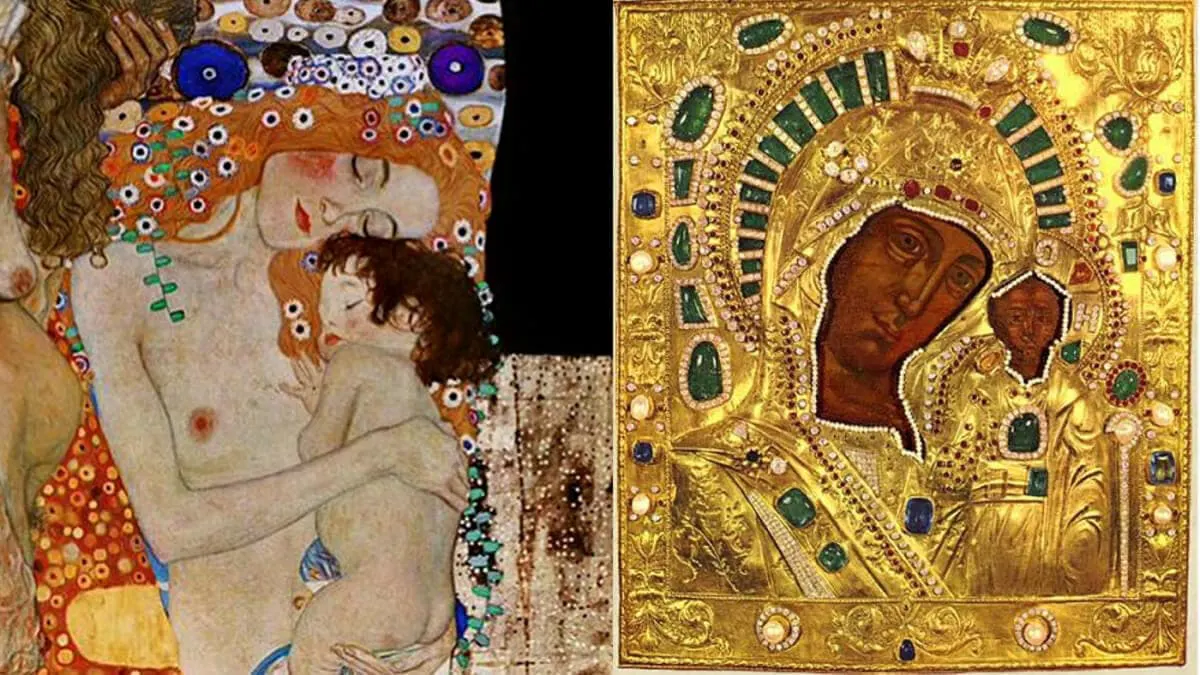
You see it too, right?
I had never heard of Our Lady of Kazan. Or for that matter, the Kazan Cathedral, which has a nice ring to it. I didn't know how to pronounce this correctly either and looking at it on paper, it felt very close to a superhero exclamation.
Doing the most natural thing in the world, I turned to Janson Google and Wikipedia and was faced with a strange and complex story. This Russian Orthodox icon once had an extraordinary responsibility, representing the Virgin Mary as a palladium to all of Russia. It later went missing, though an extremely early copy of the piece now rests again in Russia. This version is known as the Our Lady of Kazan Fatima. If you're interested in a historical sum-up of the original's misadventures, I've included this at the bottom.
There are thousands of artworks depicting the Virgin and Child and the Mother-Goddess symbols. When I first laid eyes on the Our Lady of Kazan Fatima, it appeared oddly familiar. Not in the "I've spent too much time looking at 'Virgin Mary with Child' paintings and I am disoriented from staring at all the halos" familiar. I oddly knew this artwork, but I most certainly did not know this piece of art.
Stubbornly willing the answer to appear, I suddenly knew what I had to find - a famous, respected, pioneering artist whose work had become ubiquitous - thanks to Ikea. Gustav Klimt. The Three Ages of Woman is an extremely well-known work, and Klimt's style from that period is easily recognizable. But the Mother and Child detail has an easy appeal that's hard to deny - a dreamy, doting, flower festooned mother nature (or au natural if you prefer) gently cradling her peaceful child. Perfect for the nursey.
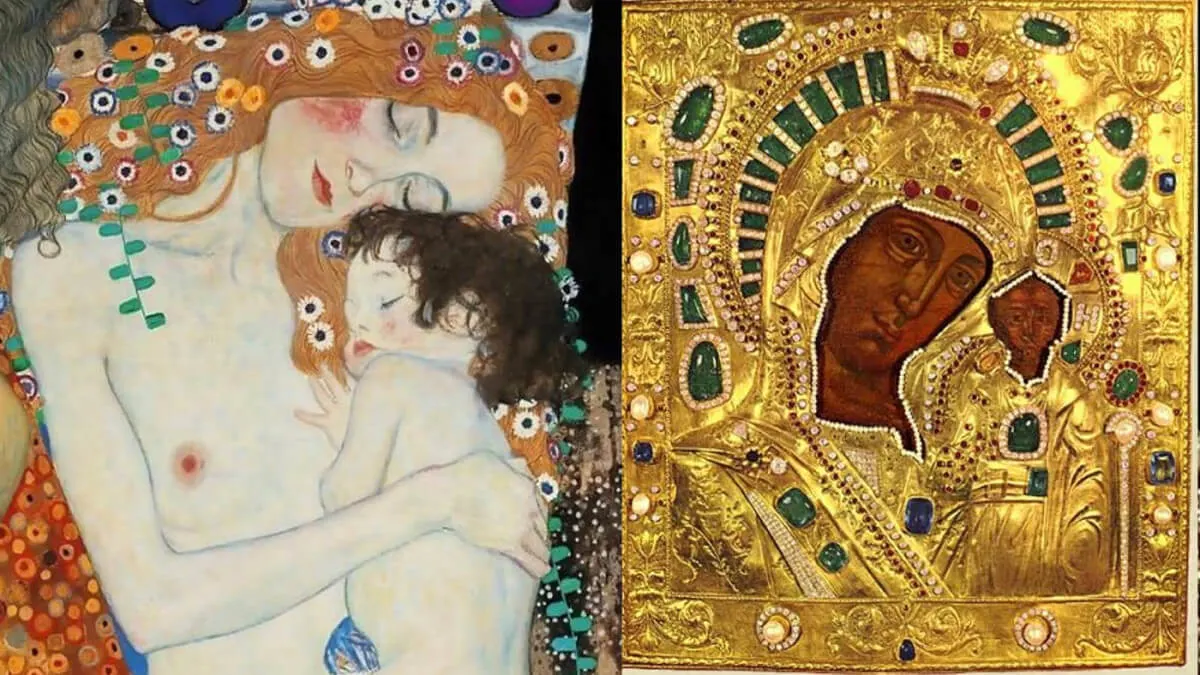
These works created centuries apart share a fun amount of echoing similarities. What you see on the right is Our Lady of Kazan (Fatima.) On the left is the immensely popular detail of Gustav Klimt's The Three Ages of Woman. Note the upright position of the Child figure in both images, in contrast to the heavy and sharp incline of the Mother figure's neck in both. The Mother in each is crowned and adorned with vibrant, luxurious decoration - in Fatima, jewels; in Klimt, jewel-tone flowers. These, all on a background of beautiful vibrant gold (or gold-tones.) Perhaps most catching is the green garland surrounding Klimt's Mother and Child, which once seen, ties the similarities together.
~
Brought to Russia from Constantinople in the 13th century, the Our Lady of Kazan icon then went missing for about 140 years. As the story goes, a young girl and her mother recovered the icon after the child had a recurring prophetic dream of its location - which was disregarded by the archbishop. His loss indeed, as the girl and her mother recovered the icon to much celebration. Churches were built and dedicated in honor of the return of this most important icon to the Russian people. For over two centuries, the icon was credited with helping achieve Russian military victories. In 1904, the icon and its bejeweled gold frame were stolen from its convent. Though the Russian police were able to recover the frame, the icon was lost. Rumors would surface over the next decades as to the location of the icon. In 1953, things get a little confusing, and costly, as what is now known as the Our Lady of Kazan Fatima image (seemingly a really early copy of the original icon) made its way from New York to Fatima, Portugal in 1970, to the Pope in 1993, and finally in 2005, found her way home to Russia.
Join our newsletter for the latest updates and special offers.
Do you have a cross-culture story or related insight to share? Write to us at contact@hopatour.com - we'd love to hear from you!
Categories: Cross-Culture