When Jesus Was Born in Kraków: The Art of Szopki Christmas Nativity Scenes
· 6 min read
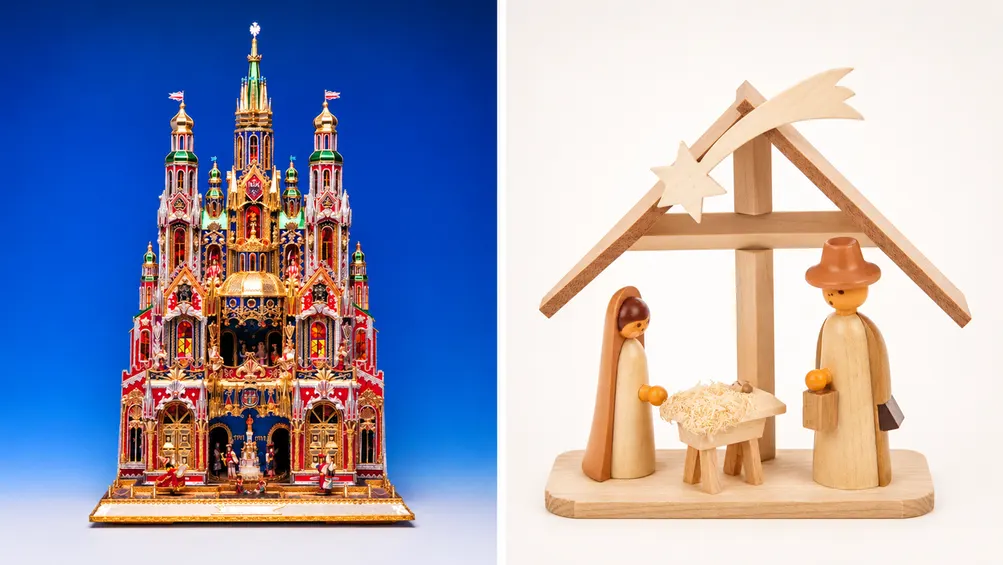
How Polish craftsmen turned Christmas Nativity scenes into extraordinary architectural folk art.
In Kraków, Poland, the birth of Jesus takes place in some rather magnificent surroundings. Instead of a humble stable, the Holy Family may appear beneath soaring Gothic towers, golden domes, and elaborate Renaissance facades. The buildings resemble Kraków's most famous landmarks, but with a few liberties taken: towers and domes grow taller, buildings from different centuries stand side by side; Kraków's legendary dragon might make an appearance, too, alongside a Polish king, a modern-day politician, or another unexpected guest at the Nativity.
These extraordinary creations are called szopki krakowskie (singular: szopka krakowska), Kraków's distinctive version of the Christmas Nativity scene. Some are small enough to fit in a hand; others stand several feet tall. Made from cardboard, wood, colored metallic foil, and other materials, they can be dazzlingly elaborate, with illuminated windows, intricate decorations, and even moving figures.
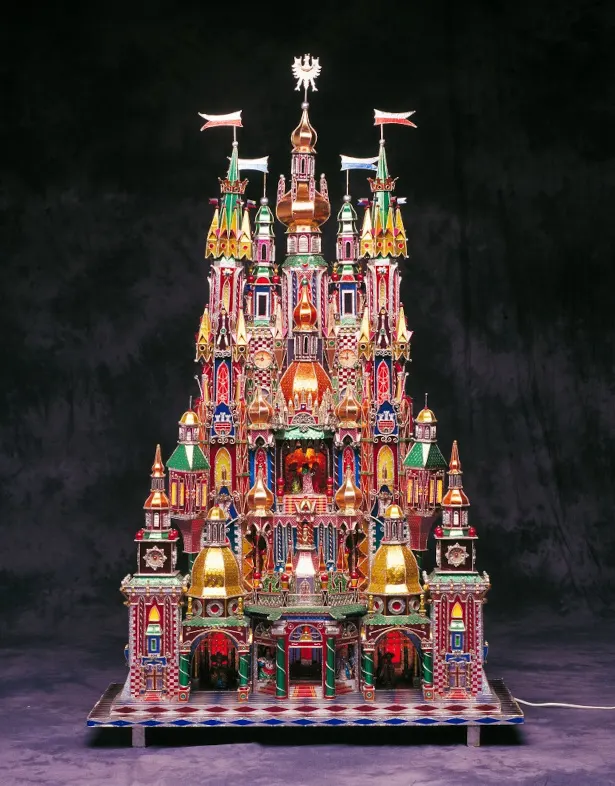
And although the Nativity remains essential, the architecture often steals the show.
The tradition began in nineteenth-century Kraków, when local construction workers found an ingenious way to earn money during the winter. Over generations, their Christmas creations developed into an art form that brings together the city's architecture, history, legends, and contemporary life.
Kraków's Builders Turned to Christmas
The origins of the szopka lie in the European tradition of displaying the Nativity in churches and homes, usually with figures of Mary, Joseph, and the infant Jesus gathered around a manger. In Kraków, however, Nativity scenes developed an unusual architectural character, thanks in large part to the city's bricklayers, carpenters, and other building craftsmen.
During the nineteenth century, construction work largely stopped in the cold winter months. To supplement their income, some workers began making Nativity scenes. Small versions could be sold as Christmas decorations, while larger creations served another purpose: they were portable stages for Christmas puppet shows.
Some of the builders were performers themselves.
During the Christmas season, performing groups gathered in Kraków's Main Market Square, displaying their elaborate creations to prospective customers. Families could hire a troupe to perform in their homes, bringing along its miniature theater, puppets, songs, and Christmas stories.
An impressive szopka helped attract an audience. As builders competed for attention, their structures became increasingly ornate. And what better inspiration for craftsmen who knew the city's buildings than Kraków's own churches, towers, and palaces?
One particularly influential maker was Michał Ezenekier, a master mason and tiler from Krowodrza, then a village outside Kraków. He led a popular performing troupe, and a remarkable szopka associated with his family, dating to the late nineteenth century, survives in Kraków's Ethnographic Museum.
Its elaborate architecture and puppet-stage design offer a glimpse of a time when these beautiful structures were also working theaters.
A Miniature Kraków Where Centuries Meet
Today's szopki preserve the architectural inventiveness of those early builders, often taking it much further.
The two unequal towers of St. Mary's Basilica, overlooking Kraków's Main Market Square, are among the most recognizable features. But a maker might combine them with the golden dome of the Sigismund Chapel at Wawel Cathedral, the Renaissance details of the Cloth Hall, or decorative elements borrowed from other historic buildings.
These aren't accurate scale models. A single szopka may combine Gothic, Renaissance, and Baroque architecture into a building that has never existed, with proportions exaggerated for dramatic effect.
The figures are equally imaginative.
Alongside the Holy Family, shepherds, and Three Wise Men, a szopka may include Polish kings, national heroes, and characters from local folklore. Kraków's legendary dragon might appear, or the Lajkonik, a colorful horseman associated with one of the city's traditional celebrations.
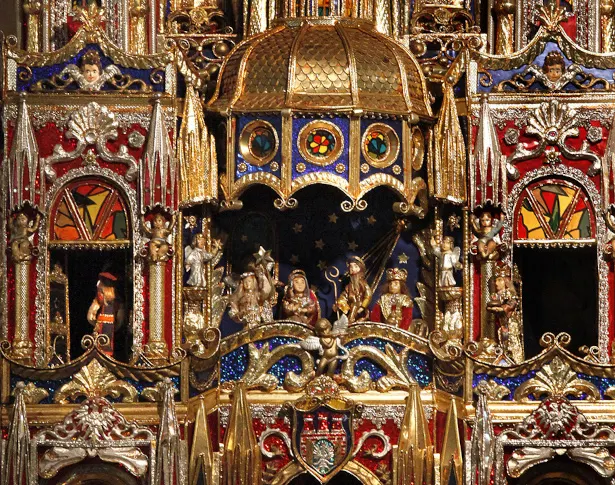
Contemporary figures can join the company, too. Artists, politicians, and other recognizable personalities sometimes find their way into the miniature scenes.
The result is an unlikely gathering of people and places from different centuries. Biblical figures share the stage with characters from Polish history, while buildings from several architectural periods are brought together in a single glittering composition.
And through it all, the Nativity remains, sometimes occupying only a small space beneath the elaborate towers.
From Puppet Theaters to Works of Art
By the early twentieth century, the custom of taking Christmas puppet shows from house to house was declining. But Kraków's elaborate Nativity scenes had acquired a life of their own.
In 1937, Jerzy Dobrzycki, a Polish cultural organizer, established a competition to help preserve the tradition. Makers brought their creations to the Main Market Square, where they were judged for their craftsmanship and artistic quality.
After an interruption during World War II, the competition resumed in 1945. The Museum of Kraków has organized it since 1946.
The competition helped transform the szopka from a portable theatrical stage into an artwork made primarily for display. Today's makers may spend months constructing their entries, carefully cutting and assembling miniature architectural details, adding colored foil, lighting, and figures. Some incorporate mechanical movement.
The tradition is also passed down within families, with children learning techniques from parents and grandparents. New makers bring their own ideas while continuing to work with Kraków's familiar architectural forms.
In 2018, UNESCO added Kraków's Nativity scene tradition to its Representative List of the Intangible Cultural Heritage of Humanity, recognizing both the craftsmanship and its importance to the city's cultural life.
The annual competition continues. On December 3, 2026, makers will once again bring their szopki to Kraków's Main Market Square, gathering beneath the Adam Mickiewicz monument before their works are taken to the Museum of Kraków for judging and exhibition.
It is a fitting setting for a tradition that has spent generations borrowing from the surrounding city.
To explore more of these extraordinary creations, visit the Museum of Kraków's online gallery of Nativity scenes by Bronisław Pięcik, featuring photographs of his elaborate szopki and their intricate details.
Every szopka offers its maker a chance to rearrange Kraków: to bring a Gothic tower together with a Renaissance dome, introduce an unexpected character, or find a new place for the Holy Family. What began as a way for wintertime craftsmen to earn a living has become an annual celebration of their city's architecture—and of what can be created with it.
Feature Image: Illustrative composite, at Left: Medium-sized Krakow nativity scene by Bronisław Pięcik, which won 1st place in the 56th Krakow Nativity Scene Competition in 1998. Nativity scene in the collection of the Krakow Museum (inventory no. MHK-252/Xa). Photo by Jacek Kubiena; Right: handcrafted wooden nativity figurine from the Erzgebirge region of Germany
References for Further Reading
UNESCO — Nativity Scene (Szopka) Tradition in Kraków. An introduction to the tradition, its craftsmanship, and its recognition as intangible cultural heritage.
Poland's National Institute of Cultural Heritage — Kraków Nativity Scene Tradition. Background on the nineteenth-century origins, construction workers, and the preservation of the craft.
Ethnographic Museum in Kraków — The Kraków Szopka Tradition. An account of the tradition's history and its relationship to local Christmas performances. (In Polish.)
Museum of Kraków — Nativity Scenes at Krzysztofory Palace. The competition's history, prominent makers, and the development of szopki as an art form.
Museum of Kraków — 84th Kraków Nativity Scene Competition, 2026. Official information about the December 2026 competition and exhibition. (In Polish.)